
Meet Loch Ness Monster
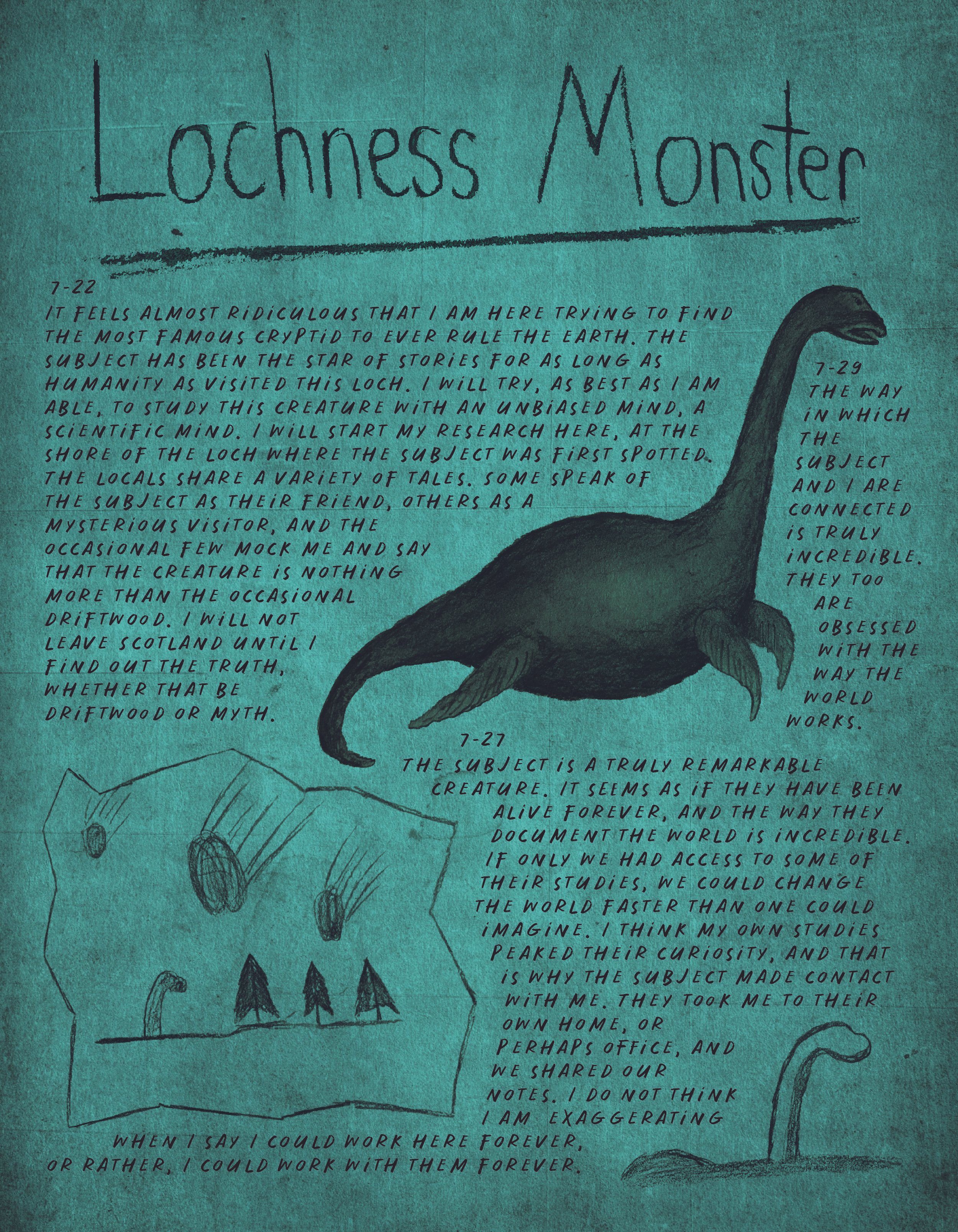
Basic Information:
Nickname: Nessie
Height: 11’1”
Eye Color: Black
Age: Approx. 200 Million Years
Location: Scotland
Hobbies: Historical Record Keeping
Getting to Know Me:
Love Language: Acts of Service
Hidden Talent: Remembering dates of historical events
Favorite Food: Sushi
Biggest Fear: Outliving Everything
Pet Peeve: Scholars who lecture on subjects they know nothing about.
Ideal Date: Going to the Library
Dating Preference:
Favorite Feature on a Person: Intelligence
Looking For: Someone who can help expand my knowledge
Dealbreaker: You believe the moon landing was fake
A Brief History of the Loch Ness Monster
Unlike many cryptids who share the world with a plethora of others in their species, the Loch Ness Monster has no such family. Believed to be an immortal holdover of the Jurassic era, the Loch Ness Monster did not, like the rest of its species, go extinct. It somehow survived and found itself trapped, by one way or another, in Loch Ness. Researchers have not discovered the cause of its immortality, but acknowledge that its wisdom is probably far greater than any other creature.
It took more than a million years for the Loch Ness Monster to be first discovered, having hidden its existence in the expanse of the loch it calls home. It was first recorded in the tales of Saint Columba, who had a confrontation with the creature. The cryptid also found itself immortalized in the folklore of Celtic writings, being the basis of kelpies, or water horses. However, in the 1930’s, the theories about Loch Ness and its creature grew even more palpable, with multiple sightings and even a photograph. Since then, tourists flock to the shores of the loch to try and catch a glimpse of the immortal dinosaur affectionately known as Nessie.
About Our Eligible Loch Ness Monster
Unlike many of the cryptids our researchers look for, we all knew the Loch Ness Monster was there. The only concern was actually making contact with the elusive cryptid. It took quite some time, but in 2007 contact was finally made, and the last of its species opened up to us. Loch Ness Monster was hesitant at first, but eventually it began to share its insights with us, even inviting us to underwater caves and air pockets where we could observe and record some of the historical data that it had recorded in their seemingly endless life.
Together, Loch Ness Monster and our researchers have spent countless hours comparing notes and data, trying our best to fill in the gaps of missing knowledge. In this process, several of the researchers have found themselves developing feelings for the dinosaur, though it is undetermined whether the cryptid returns those same feelings.